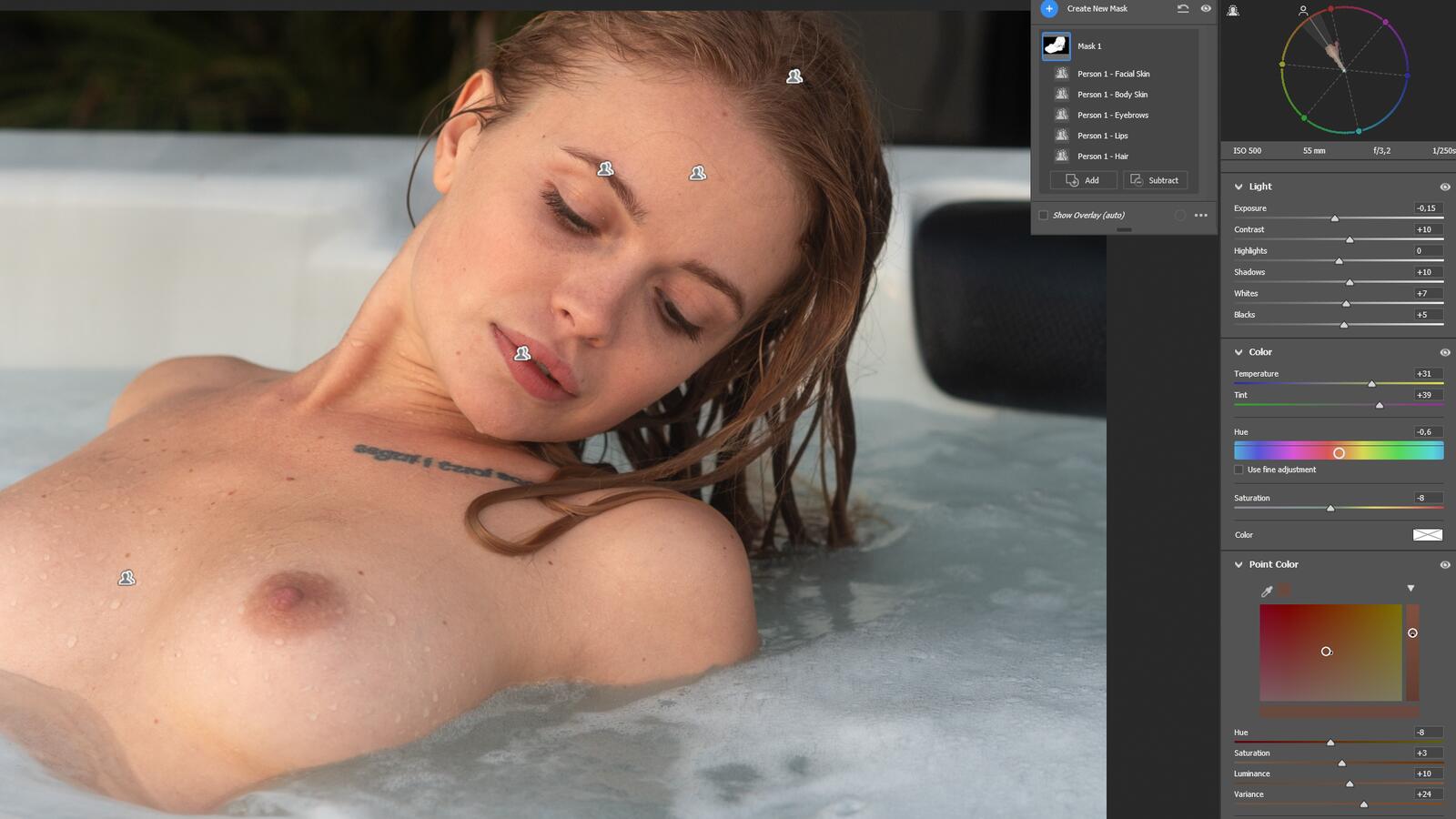
A diagram can't tell me whether a shot looks good. It can tell me where the color values sit: hue on the circle, saturation as distance from the center. And whether the skin lands on the famous "skin line," that diagonal between red and yellow where human skin ends up regardless of pigmentation. A lovely biological truth. It just doesn't make a picture.
That should settle it. Eye beats diagram, time to go home. Except there's a catch. My eye, it turns out, is a cheat.
It adapts, constantly. Late in the evening, sun hitting the display from the side, some strange hotel monitor still running its factory settings from 2015: right when I'm most sure of myself is exactly when I'm furthest off. The eye gets used to any garbage. The Vectorscope doesn't. It's my second opinion for conditions I can't trust.
Then there's the drift. After two hours of editing, image fifty looks different from image one, because my perception quietly wanders along with me. For a single photo, that doesn't matter. For a calendar or a book, where the shots sit side by side, consistency across the whole series counts for more than the one perfect image. The skin line gives me a fixed anchor, even when my head checked out long ago.
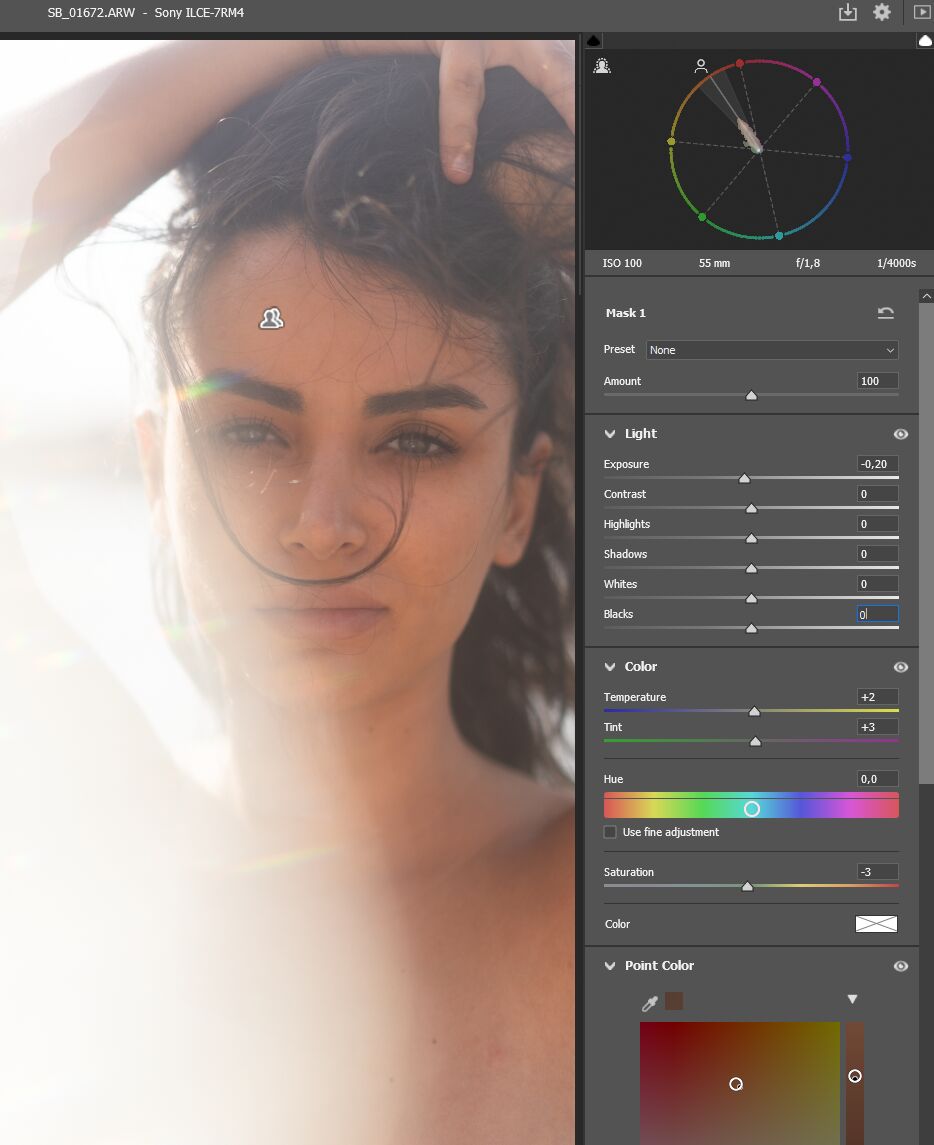
Then the color casts I've gotten used to. Mixed light, a green reflection off the leaves, warm spill from a wall. Over time the eye factors that out, and at some point I simply stop seeing it. The dot in the diagram drifts visibly off the line anyway, unmoved and incorruptible.
Often I care less about hue than about saturation, which is to say distance from the center. Right after one of my LUTs, I can tell at a glance whether I've cooked the skin. Not the question "is the tone right," but "did I want too much."
Pulling it up is quick. I go to Filter, into Camera Raw Filter, right-click the histogram in the top right, and choose "Show Vectorscope." Since the diagram would otherwise show me the colors of the entire image, I mask the person first and isolate the skin tones, and then only what interests me is left. Now I work the sliders: hue onto the line, saturation and luminance by feel.
By feel, yes. Because this is exactly where my eye comes back into play, deliberately. The Vectorscope is my starting point, not my destination. First I push the skin cleanly onto the line, then I deviate on purpose, because golden evening skin isn't supposed to look neutral. The only difference is that now I know I'm eight degrees too warm because I want it that way, and not because a hotel room and a long day played a trick on me.
If you don't have Photoshop at hand, you can try out a vectorscope with your own photo below.
Vectorscope Demo
Drop a photo hereor choose one
Image
Trace
Gain
Skin tone line
Brightness
No image loaded yet.