Except: What exactly are we supposed to be labeling here?
My images are all manipulated. Every single one. They always have been. In the late 1990s, I used the clone stamp tool in Photoshop to retouch skin blemishes; today an "intelligent" eraser does the job. It decides on its own whether to use autofill or generative fill. I paint over a distracting area with my drawing tablet, the tool does the rest. Is that AI now? Probably. Do I need to label it? No idea.
I remove pimples, bruises, spider veins, cellulite. Almost always moles too (Cindy Crawford would have gotten an exception). These are the beauty standards of my industry. I didn't invent them, I just follow them. I don't enjoy doing it because it would be easier for my workflow to use photos straight out of the camera. But that's not how the business works, and honestly, it also aligns with my own aesthetic sensibility. Celebrating beauty.
The thing is, I'm exclusively focused on removing distracting elements. I don't optimize the model. The person remains the main subject, their physical features stay unchanged. No longer legs, no new hairstyle, no inflated lips, no altered cheekbones, no narrower waist, no larger breasts. All of that would be possible today with AI tools. I could completely rebuild people if I wanted to. But I don't. The time investment would be absurd for entire photo shoots. And it's definitely not interesting for me to incorporate AI in such a way.
Still, I manipulate. The question is just: where does manipulation begin?
Every smartphone manipulates automatically these days. They call it computational photography. HDR algorithms, night mode, portrait effects – all software that interprets, decides, changes. Nobody photographs "directly" anymore. That doesn't exist. Even with an analog camera, the film determines grain, color rendition, and contrast; the exposure determines mood; the development process determines the final result.
So what is a "true" image?
In journalistic, documentary contexts, AI use should be minimal. There it's about credibility, about facts, about reality (as far as it exists). But in commercial photography, in art? Manipulation has always been part of the craft.
The labeling requirement is meant to prevent people from being deceived. The goal is right. But the implementation is complicated. Should I add a notice to every image: "Warning, pimples were removed here"? Will that surprise anyone? Does anyone seriously believe that images in magazines or advertising campaigns are unedited?
Maybe the problem runs deeper. Maybe it's not about labeling, but about our expectations. We know images are manipulated, but we act as if they're real. We see perfect bodies and flawless skin and compare them to ourselves, even though we actually know there's been retouching.
I'm afraid it'll just lead to more labels that nobody reads. Like privacy policies and cookie banners.
I'm in a gray zone. If I label images, it'll create a strange impression. I'm not adding anything, I'm only removing. The tourist who absolutely wouldn't get out of the frame and just had to watch at the beach. The power strip that was so obtrusively distracting from the subject. And then I write underneath: "Edited with AI."
What will people think then? That the photo isn't real? That I completely recreated the model? That none of it is true? When all I did was clean up the distracting things reality brought along. That's the difference between an edited image and a generated image. But how will this nuance be recognizable in the labeling?
There are so many questions. What exactly does this labeling even look like? Text under the image? An icon? Watermarks? Metadata that nobody reads or that gets stripped when you upload to social media?
Do we really need more rules?
Maybe we should simply accept that every image is an interpretation. That photography has always been construction, never pure representation. Truth is whatever remains after all the editing steps anyway. And that's always been subjective.
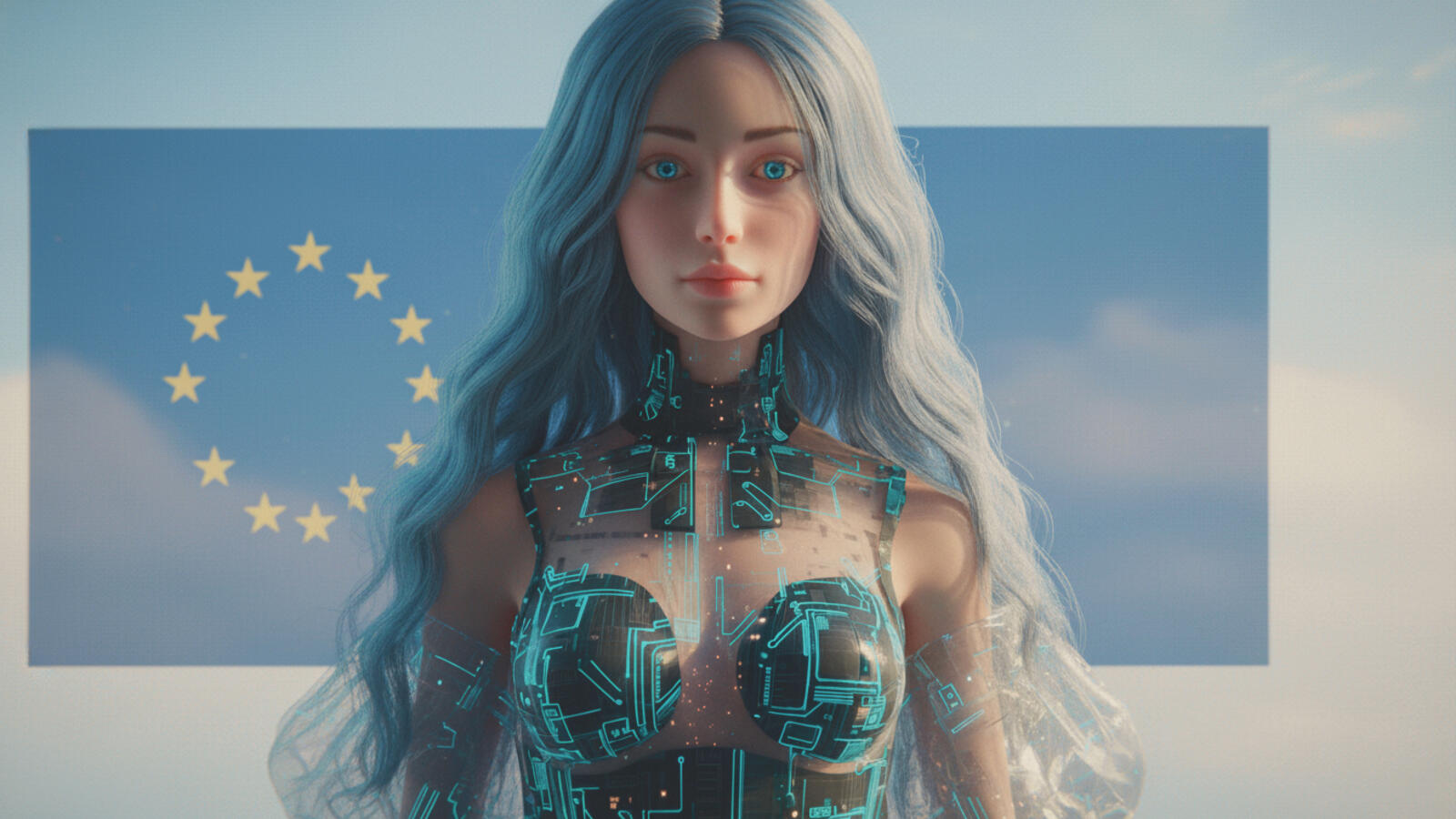
P.S. The header image for this article is not a photograph. It was 100% generated with Nano Banana AI.
Addendum
While the new EU law primarily targets deepfakes, and there are legitimate doubts about whether bad actors will comply with it, I have conscientiously implemented the disclosure requirement. In the rare instances where I use AI-generated content — such as roughly 1% of my blog article images — I have added the appropriate labeling.